Build from an ASIN
Pull available listing data from Amazon and use it as a starting point for your plan.
Plan your Amazon launch before you order inventory.
Estimate profit, margin, ROI, break-even, startup investment and payback for your Amazon launch.
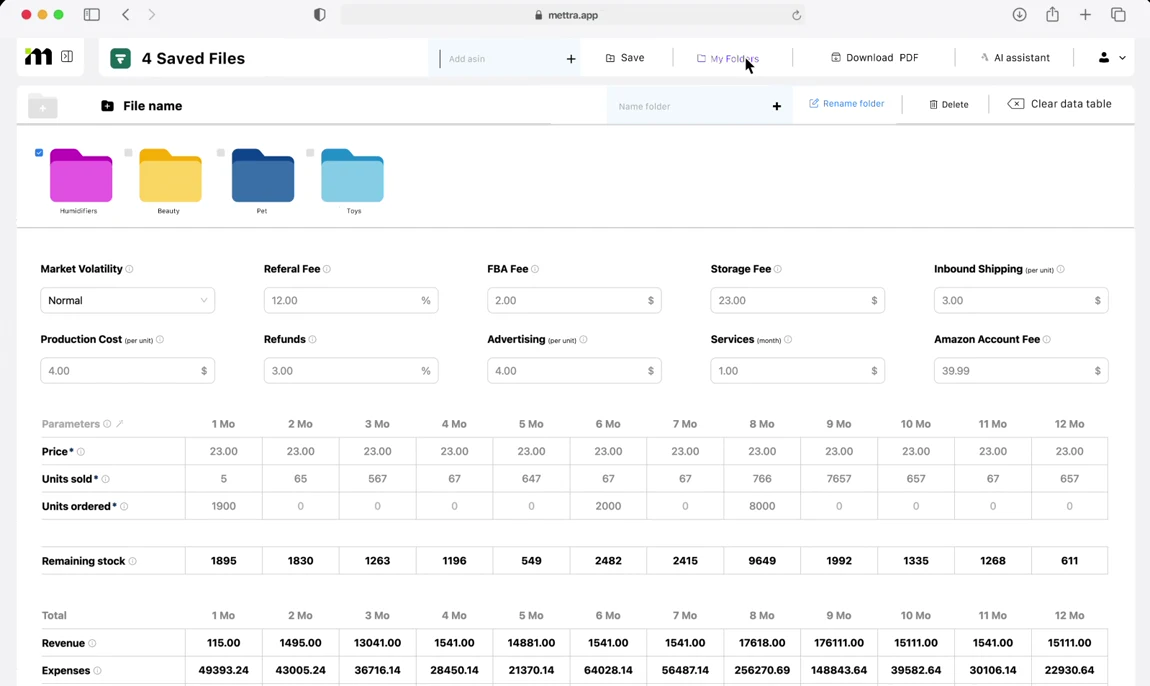
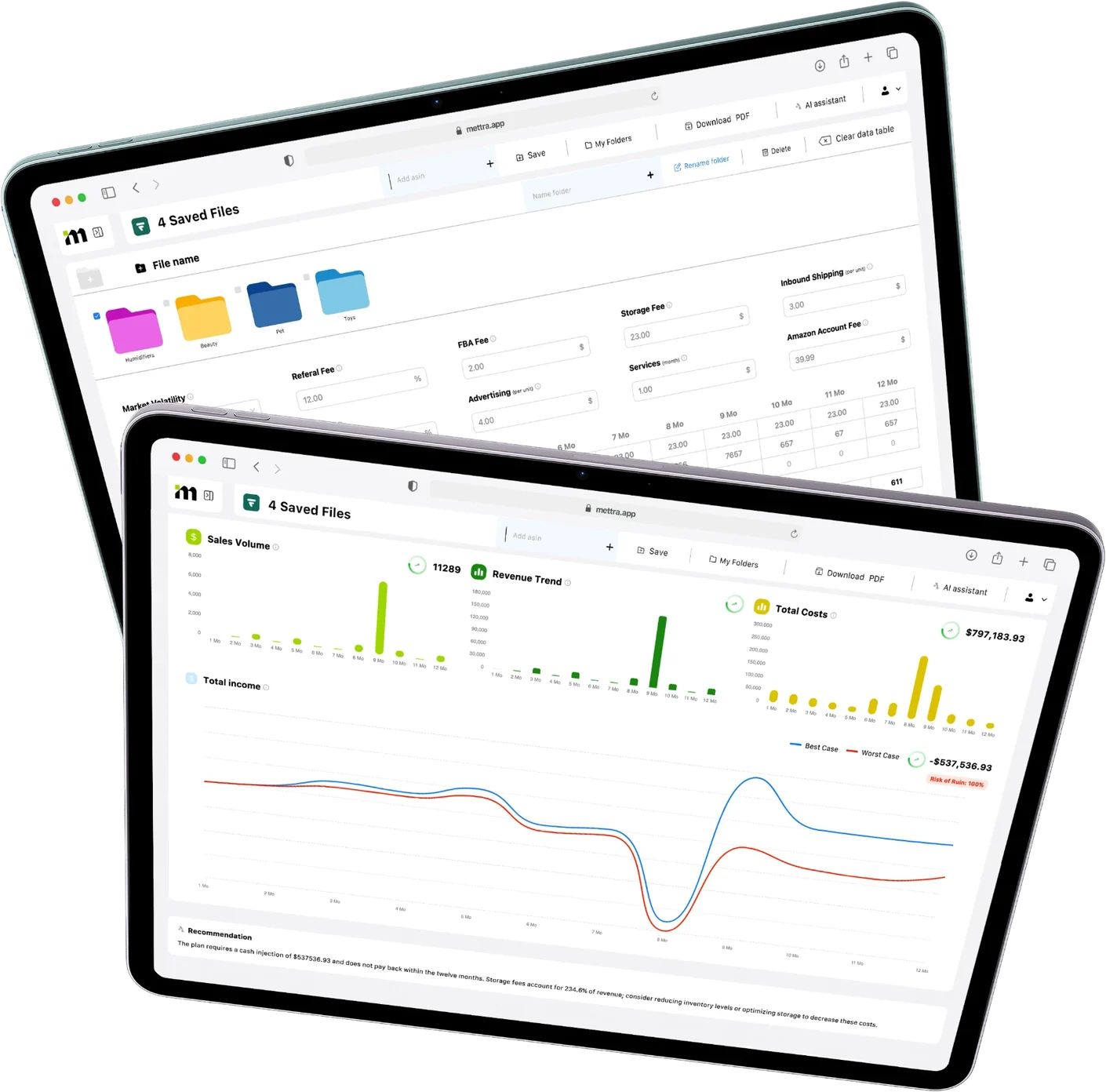
Build from your own assumptions or use a competitor’s ASIN to prefill available data. Then test the costs and sales your plan depends on.
Include product cost, freight, Amazon fees, ads and other expenses to estimate net profit, margin and ROI.
Estimate inventory and launch costs, then see when sales could recover your initial investment.
Vary price, ad spend and sales to compare outcomes before placing an order.

Watch how a product plan brings costs, fees, monthly forecasts and saved models into one workspace.
Open Financial ModelChange the inputs to see what happens to profit, break-even price and the month you recover your investment.
This example uses a 15% referral fee, $5.16 fulfillment cost and $1.65 for storage and returns per unit. Startup investment is 1,200 units at landed cost plus a $2,800 launch reserve. The forecast assumes steady monthly sales and replenishment at the same landed cost.
Net profit per unit is sale price less all per-unit costs. Unit ROI is net profit per unit divided by landed cost. Break-even price is fixed per-unit costs divided by one minus the ad and referral fee percentages. Payback is the first month when cumulative operating profit covers the startup investment.
Build, test and share your launch plan from one workspace.
Previews use sample data.Pull available listing data from Amazon and use it as a starting point for your plan.
Choose how much prices and sales can vary over the forecast.
See how changes in demand and price affect possible outcomes.
Copy values you already entered into related fields as you build the model.
Group product plans by project or niche so you can revisit and compare them.
Keep a copy of your forecast or share the plan with a team or partner.
Mettra Academy walks you through cost inputs, scenario settings and how to read the forecast before you commit to inventory.
Compare what it takes to build, test and review the same Amazon launch plan.
| Planning task | Spreadsheet workflow | With Mettra |
|---|---|---|
| Start a model | Collect listing prices and fees, then enter them into a template. | Start from an ASIN to prefill available data, or build from your own inputs. |
| Calculate unit economics | Build formulas for fees, costs, profit, margin, ROI and break-even. | Enter costs and see how price, fees and ads change what you keep per sale. |
| Plan investment and payback | Link sales, orders and expenses across monthly sheets. | See required startup cash and when the 12-month plan can recover it. |
| Stress-test the forecast | Duplicate the sheet and adjust sales and prices for each case. | Set volatility and review a range of outcomes from 5,000 market scenarios. |
| Review assumptions | Check figures and look for cost or pricing risks manually. | Use the AI Agent to help fill inputs and review cost and pricing assumptions. |
| Save and share | Manage copies of spreadsheets and create a report for your team. | Save models in folders and export the results to PDF. |
It is a planning tool for Amazon sellers. Use your costs, sales estimates and inventory plan to forecast profit, cash needs and payback over 12 months.
Include product cost, freight, Amazon referral and fulfillment fees, advertising, taxes and other expenses that apply to your product.
Yes. Mettra can load available Amazon listing data to start a model. Replace the estimates with your own supplier, shipping and launch costs.
The Mettra AI Agent can help populate the model from your request and product data. Review the inputs against your own costs before you use the forecast.
The AI Agent can highlight which costs, prices and other assumptions are most important to review, and suggest adjustments to test.
Yes. The model calculates estimated net profit, margin and ROI from the costs and sales assumptions you enter.
Yes. Use the break-even calculation to see when revenue can cover costs under your current assumptions.
Include the planned inventory orders and launch costs in the monthly forecast. The model shows how much upfront cash the plan needs and when that cash could be recovered.
Build an Amazon launch plan around your costs, sales assumptions and budget.