Back to blog
Port Congestion Absorbs 8.5% of Global Shipping Capacity
Port congestion is currently absorbing 8.5% of global shipping capacity.
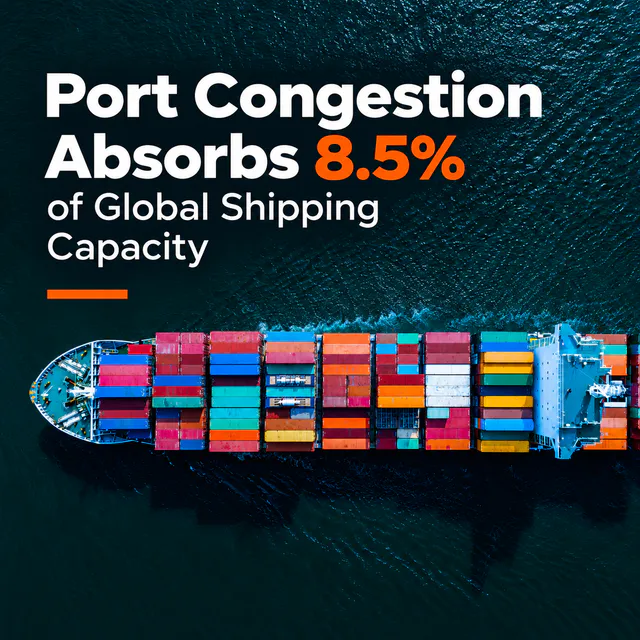
Port congestion is currently absorbing 8.5% of global shipping capacity.
Global container shipping is experiencing a severe capacity squeeze, with vessel delays at major international ports effectively removing 8.5% of the world's containership fleet from active service. According to research published by maritime analytics firm Sea-Intelligence, severe port congestion and vessel queueing now tie up approximately 3 million TEU (twenty-foot equivalent units) of container capacity worldwide. This represents a rapid escalation from mid-August, when delayed capacity stood at 1.7 million TEU—marking a capacity drain expansion of over 75% in roughly six weeks.
To understand the sheer magnitude of 3 million TEU, consider that if this immobilized capacity were consolidated into a single ocean carrier, it would rank as the fifth-largest container shipping line on earth—positioned directly between global giants COSCO Shipping and Hapag-Lloyd. These vessels have not been decommissioned or withdrawn from commercial service; they remain fully operational in carrier networks. However, extended berth waiting times, high terminal yard density, and port bottlenecks mean ocean carriers require substantially more vessel capacity simply to transport the same volume of freight across primary trade routes.
As port backlogs expanded across key trade corridors, global container schedule reliability fell to 49.9% in August, crossing below the 50% threshold for the first time since September 2022. For container vessels that failed to meet their published berth windows, the average delay rose sharply to 6.8 days behind schedule—the highest figure recorded since early 2022. This operational breakdown was heavily driven by severe disruptions across East Asian gateways. A series of late-summer typhoons repeatedly disrupted operations at primary Chinese export hubs, including Shanghai and Ningbo, where terminal reliability plunged to between 12% and 21%.
"Sea-Intelligence estimates container vessel delays are tying up 8.5% of the global fleet, roughly 3 million TEU. Global schedule reliability fell below 50% in August, with late vessels averaging 6.8 days behind schedule."
The operational impact of origin port congestion quickly cascades through international trade lanes. When container ships face multi-day berth waiting times at primary origin ports, ocean carriers frequently resort to port omissions—skipping scheduled terminal calls to recover lost time on subsequent legs. While omitting a port call may allow an individual vessel to recover part of its timetable, it leaves thousands of containers stranded on origin docks and redirects cargo to adjacent regional gateways. This creates secondary bottlenecks across Southeast Asian transshipment hubs and European destination ports, multiplying total transit times across the network.
During periods of widespread maritime disruption, logistics forwarders and ocean carriers may highlight published sailing schedules as proof that ocean space remains abundant. Sea-Intelligence addressed this paradox in an analysis of pre-Golden Week capacity on the Asia-North Europe trade route. Scheduled container capacity over a four-week window reached 1.5 million TEU—a 27% increase compared to the same calendar period a year earlier.
On paper, a 27% year-over-year increase in scheduled sailings suggests plentiful transport capacity. In practice, however, much of this apparent capacity surge resulted from delayed vessels accumulating alongside regularly scheduled departures. Multiple container vessels arriving in port within the same week frequently reflect cumulative operational backlogs rather than an intentional expansion of available shipping capacity. E-commerce sellers and logistics buyers must look beyond headline schedule numbers and request detailed voyage data from forwarders, including specific vessel names, voyage numbers, origin terminal cutoffs, transshipment plans, and confirmed bill of lading receipts rather than relying on booking confirmations alone.
Global maritime networks do not recover overnight from severe capacity absorption. Applying historical recovery rates from previous major shipping disruptions—such as the post-pandemic backlog and the Red Sea diversion crisis—Sea-Intelligence projects that returning to the lower congestion levels recorded in June 2025 will require seven to ten months. Restoring conditions even to the baseline observed at the end of 2025 is estimated to take six to eight months.
This prolonged recovery timeline creates a major strategic challenge for retail supply chains. With Chinese New Year arriving early on February 6, 2027, the traditional pre-holiday export rush will hit Asian ports long before current congestion fully unbinds. E-commerce brands and Amazon sellers must treat port congestion as a structural, persistent supply chain constraint rather than a short-term weather disturbance. Reorder models, safety stock calculations, and lead-time assumptions must account for extended transit times throughout the Q4 peak shopping season and well into 2027.
Navigating widespread fleet congestion requires moving beyond generic lead-time assumptions. The reported average delay of 6.8 days applies strictly to vessels that miss schedule windows, and ocean transit represents only one component of total landside delivery. To build resilient inventory models, sellers must map an end-to-end timeline covering every touchpoint between factory production and sellable Amazon FBA inventory.
A comprehensive replenishment schedule must factor in origin port dwell time, ocean sailing schedules, transshipment transfers, destination port waiting times, customs clearance, inland drayage, and 3PL or FBA receiving appointments. Amazon sellers should maintain two parallel inventory forecasts for top-performing SKUs: a baseline schedule and a delayed contingency scenario. Furthermore, inventory cover metrics must strictly exclude reserved, damaged, or unfulfillable units. Relying on raw total inventory balances can create a false sense of security while fulfillable stock available to buyers runs critically low.
When ocean vessel delays threaten inventory availability, emergency airfreight is frequently proposed as a solution. However, airfreight should be used targetedly to bridge a precise inventory gap rather than as an automatic reaction for entire purchase orders. Sellers must evaluate the cost of expedited airfreight directly against the contribution margin protected by avoiding a stockout.
For example, consider a product selling 20 units daily with an $8 unit contribution margin before emergency freight expenses. A 10-day stockout exposes 200 orders, representing $1,600 in lost contribution margin. Air-shipping precisely 200 gap units at an additional $4 per unit costs $800, generating $800 in net benefit while maintaining search ranking and buy-box momentum. Conversely, air-shipping the full 2,000-unit reorder at the same $4 premium adds $8,000 in shipping expense—far exceeding the financial damage of the stockout itself. Additionally, sellers can adjust active promotional discounts and coupons to moderate sales velocity, stretching existing stock cover until delayed ocean inventory arrives.
Macro supply chain shocks like port congestion absorbing 8.5% of global fleet capacity directly transform marketplace dynamics, inventory availability, and competitor strategies across the Amazon ecosystem. As delayed shipments disrupt inventory flow across entire product lines, stockouts and changing buy-box dynamics alter search visibility and promotional intensity within specific categories.
Capitalizing on these market shifts requires continuous niche analysis. By evaluating category-level stock levels, pricing movements, and market share shifts across competing listings, sellers can identify which product niches face inventory gaps and adjust pricing, ad spend, and stock allocation accordingly. Grounding your strategy in real-time category intelligence enables you to capture demand during competitor stockouts while protecting unit profitability through global supply chain disruptions.
U.S. Customs and Border Protection wants import bonds required on low-value imports.
Read article