Back to blog
FCC Rule Taking Effect October 13 Reaches Into Bill of Materials
A new FCC rule taking effect on October 13 reaches into product bills of materials.
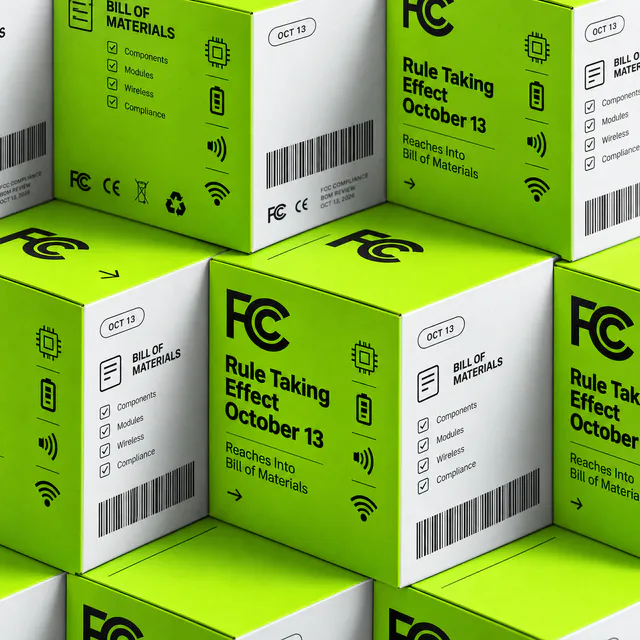
A new FCC rule taking effect on October 13 reaches into product bills of materials.
For years, importers and e-commerce brands selling electronic devices in the United States evaluated Federal Communications Commission (FCC) compliance primarily at the finished-goods level. If a product bore a clean brand name, passed radiofrequency testing at an accredited laboratory, and was manufactured by a company not flagged on the FCC Covered List, the pathway to equipment authorization was straightforward. That regulatory boundary has now fundamentally changed. Under FCC 26-50 (ET Docket No. 21-232), a major regulatory order taking effect on October 13, 2026, the FCC is extending its enforcement reach directly into product Bills of Materials (BOM).
The rule officially closes what regulators have termed the "component part loophole." Under prior rules, finished devices manufactured by listed entities—companies deemed to present an unacceptable risk to national security—were barred from receiving equipment authorizations. However, products manufactured by non-listed companies could still incorporate internal microchips, radio modules, or processors produced by those restricted entities without triggering a block. The new rule eliminates this distinction by focusing on what is inside the device rather than whose logo appears on the exterior packaging.
FCC 26-50 prohibits authorization of a device containing a logic-bearing hardware component made by an entity on the FCC Covered List, when the finished device would have been barred had that listed entity produced the whole product.
If you market wireless accessories, smart-home products, connected cameras, routers, wearables, drones, power equipment, or any consumer hardware emitting radiofrequency energy in the U.S., regulatory compliance is no longer just a legal formality completed at the end of product design. It is now an active supply chain discipline requiring complete visibility into your component suppliers.
To understand the scope of the new rule, sellers must understand how broadly the FCC defines "logic-bearing hardware." Codified under 47 C.F.R. § 2.902, the term encompasses any physical device, system, module, sub-assembly, integrated circuit (IC), or component that generates and uses timing signals or digital pulses. In practical terms, this definition captures virtually any hardware component capable of performing digital processing, data storage, data transfer, or radiofrequency signal processing.
This means the regulatory inquiry extends far beyond obvious components like primary system-on-chip (SoC) processors. It reaches microcontrollers (MCUs) managing power distribution, Wi-Fi and Bluetooth communication modules, digital signal processors (DSPs), cellular transceivers, GPS chips, and specialized logic controllers integrated onto secondary circuit boards.
A clean brand identity on the retail box or an established brand registry listing on Amazon offers no protection if an underlying logic-bearing component comes from a Covered List entity. Even if a product is assembled in a non-restricted region, such as Vietnam or Taiwan, a single restricted processing chip or wireless module embedded on the main printed circuit board (PCB) renders the entire device ineligible for new FCC equipment authorization.
The timing of the new rule creates a sharp divide between existing inventory and upcoming product launches. The prohibition on logic-bearing components applies to all new equipment authorization applications filed on or after October 13, 2026. Equipment authorizations granted prior to October 13 remain valid, and existing authorized products currently shipping in commerce are not automatically cancelled or recalled under this rule.
Applications pending with Telecommunication Certification Bodies (TCBs) or the FCC on the effective date receive transitional treatment. However, that transition is fragile: if an applicant modifies a pending filing after October 13 to add, replace, or swap a relevant logic-bearing component, the entire application becomes subject to the new restrictive component rules.
The primary vulnerability for active e-commerce brands lies in hardware revisions and engineering change orders (ECOs). In consumer electronics manufacturing, overseas factories frequently substitute microcontrollers or secondary ICs when primary parts suffer supply chain shortages or price spikes. If a factory swaps a logic-bearing component for an alternative part after initial testing, that change may require a permissive change filing or a brand-new certification. The moment a new authorization filing is required, the updated device must pass the logic-bearing component test. A routine factory chip swap can instantly transform a compliant product line into an unauthorized device that cannot be legally imported or marketed.
The scope of FCC 26-50 extends beyond equipment authorization applications into the e-commerce channels where these devices are sold. Building on previous enforcement initiatives like "Operation Clean Carts"—which resulted in millions of unauthorized electronics listings being removed from online platforms—the FCC clarified that online marketplaces share compliance liability when their service offerings amount to marketing radiofrequency equipment. The order specifically identified services such as warehousing, inventory management, order processing, packaging, billing, and fulfillment as relevant to this liability analysis.
To enforce compliance at the point of sale, the FCC established a staggered compliance timeline for online marketplaces to display valid FCC IDs on product listings. Beginning March 1, 2027, marketplaces that sell their own devices, take title to third-party goods, or physically handle and fulfill products (such as Amazon FBA or Walmart Fulfillment Services) must display valid and accurate FCC IDs directly on the online point-of-sale display.
Beginning June 1, 2027, pure host marketplaces that neither take title nor physically handle inventory must comply by displaying FCC IDs, verifying those IDs against the official FCC Equipment Authorization System database, and collecting explicit seller confirmations.
Although limited exceptions exist for certain low-volume third-party sellers, older qualifying listings, and used items, brand owners should not expect e-commerce platforms to grant loose exemptions. Major marketplaces routinely enforce uniform automated controls. Sellers should anticipate that marketplaces will implement mandatory FCC ID submission fields and automated database cross-checks well ahead of the 2027 deadlines, locking listings that lack verifiable compliance documentation.
Relying on a factory representative's verbal assurance that a device is "FCC approved" or "fully certified" has always been risky, but under the new rule, it is a liability landmine. Sellers must transition to rigorous, evidence-based catalog auditing.
Start by isolating every SKU in your catalog that intentionally transmits radiofrequency energy (Wi-Fi, Bluetooth, cellular, LoRa, or satellite) or operates as an unintentional radiator containing high-speed digital logic. For every identified product, request the official FCC authorization record, complete test reports, grantee name, and explicit model coverage documentation from your manufacturer.
Next, audit the actual physical hardware against official records. Obtain a detailed component-level Bill of Materials (BOM) for every PCB assembly. Identify the exact manufacturer, part number, and origin for all processors, microcontrollers, radio modules, and integrated logic circuits.
Cross-reference the grantee and component manufacturer details against the FCC Covered List. Ensure that your supply agreements explicitly forbid component substitutions without prior written approval and fresh lab verification. For high-volume or critical product lines, consider engaging an accredited independent testing lab or compliance specialist to verify internal PCB layouts before issuing purchase orders for upcoming production runs.
From a financial perspective, component compliance is no longer a peripheral legal expense; it is a critical driver of inventory valuation, working capital efficiency, and gross margin protection. If an unapproved component substitution triggers an FCC authorization block or listing suppression on Amazon, the financial consequences accumulate rapidly. Capital tied up in stranded ocean freight, rejected warehouse inventory, or suppressed product listings generates immediate storage surcharges, lost sales momentum, and severe cash flow drag.
Furthermore, the cost of emergency redesigns, component sourcing swaps, and secondary lab certifications can easily run into tens of thousands of dollars per SKU—draining profit margins on seasonal or low-margin electronics. By conducting deep BOM audits now and securing verified component documentation before new authorization filings or marketplace enforcement phases take effect, brands protect their catalog liquidity and safeguard their bottom line against catastrophic supply chain halts.
Walmart executive Scott Humanek announced Boston Mountain Customs, an owned US customs broker designed to integrate freight, entry filing, and WFS fulfillment.
Read article